
Cappella Restaurant, Needham, MA

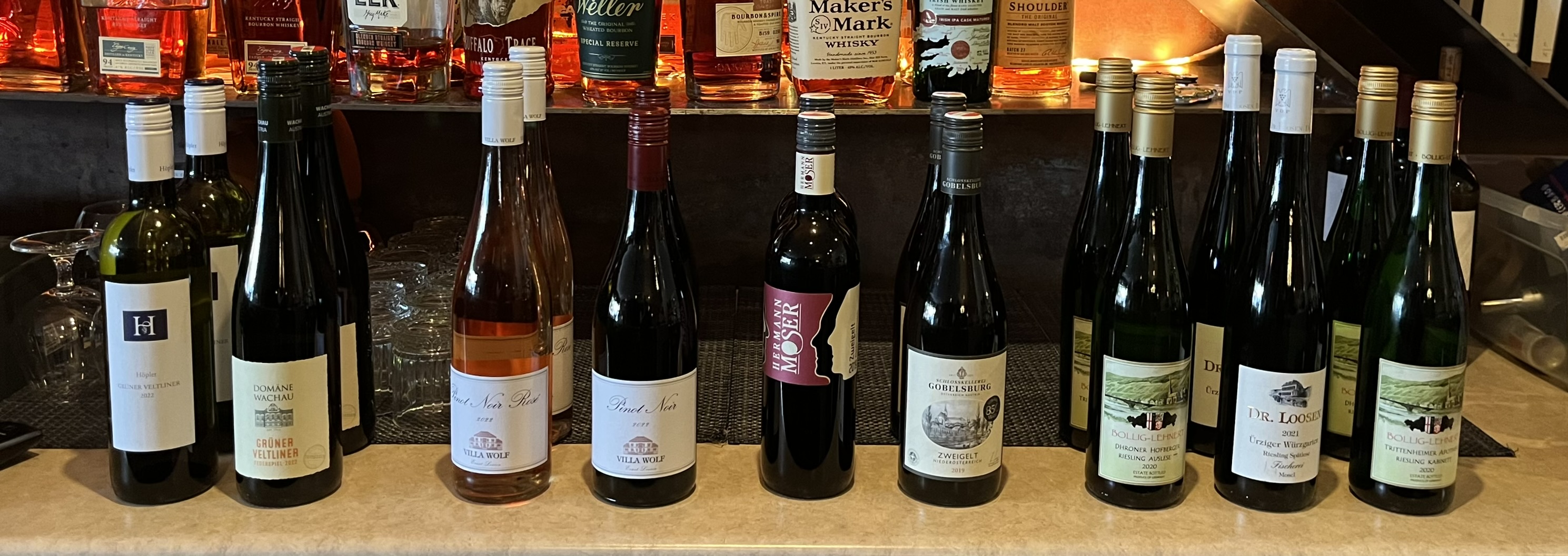
Another season-ending wine event at Cappella in Needham. This afternoon a full house tasted through a range of German and Austrian wines, paired beautifully with a series of delectable plates.
And now, a little bit about the wines of Germany and Austria.
Germany
Germany has a long and important history of wine making. Although wild vines can be traced back to prehistoric times along the Rhine River valley, the first example of organized viticulture using the noble vitis vinifera vine begins around AD 800. As it was in most of Europe, these first organized viticultural efforts were a result of Roman colonization. Wine making continued into the Middle Ages, where the spread of Christianity served to bolster the production of wine along the Rhine. Late in this period of time, the greatest vineyard sites of Germany were finally planted along the hilly slopes of the Rheingau, the Mosel, the Saar and the Ruwer.
Germany – Wine Regions
Let’s start with an overview of German wine geography. It is a wonder that grapes ripen, let alone grow in Germany given the northern latitude and tough winter climate. For this reason, all the best wine producing regions in Germany are found along rivers and lakes. The moderating effects of these bodies of water, combined with vineyards planted on south-facing slopes allow Germany to grow and ripen grapes suitable for winemaking.
There are thirteen major winemaking regions in Germany, referred to as anbaugebiete. Of these thirteen regions, eleven are located near the western border clustered along the Rhine River and its many tributaries (such as the Mosel and the Ruwer). The other two regions are found in what was once called East Germany.
The thirteen regions are:
| Ahr | Baden | Franken |
| Hessische Bergstrasse | Mittlerhein | Mosel-Saar-Ruwer |
| Nahe | Rheingau | Rheinhessen |
| Pfalz | Wurttemberg | *Saale-Unstrut and Sachen |
Of these, the most popular and probably most prevalent are the Mosel-Saar-Ruwer, Rheingau, Rheinhessen and Nahe.

Germany – Wine Laws
German wine laws consist of two components: regions and ripeness, with each having an interrelated hierarchy, hence the complexity and confusion. First, let’s examine regions. As I stated previously, Germany has thirteen major regions called anbaugebiete. Within each of these regions is a subset of lesser districts called bereiche. Currently there are thirty-nine (39) different bereiche spread amongst Germany’s major regions. These districts are further broken into general sites called grosslagen. Currently there are one hundred and sixty (160) grosslagen varying in size from 125 acres to over 5,000 acres within the different bereiche. Lastly, these general sites are broken down further into individual vineyards called einzellagen. There are well over two thousand six hundred (2,600+) einzellagen spread throughout the many grosslagen, with one of the smallest and most famous being the Doctor vineyard in Bernkastel. Generally, there is no way of knowing which location a wine is listing on its label unless one checks a wine map. Anbaugebiete are almost always listed on a label, but a winery may list the bereiche, grosslagen or einzellagen, or combinations thereof. However, it’s safe to say, as in most countries, the more specific the location listed, the better is the presumed quality of the wine.
| Regions | Districts | General Sites | Vineyards |
| Anbaugebiete | Bereiche | Grosslagen | Einzellagen |
| (13) | (39) | (160) | (2,600+) |
Second, let’s examine ripeness. German wines in addition to listing one or more regions (within the aforementioned hierarchy) are all ranked according to quality. Further delineation is made at the highest quality level, where a sub-ranking of grape ripeness is used to further specify quality. The German wine quality hierarchy consists of four levels, in ascending order from lowest to highest quality: Taflewein (Table Wine), Landwein (Land Wine), Qualitätswein Bestimmter Anbaugebiet(QbA) (Quality Wine from a Specific Region), and Qualitätswein Mit Pradikat (QmP) (Quality Wine with Distinction). Generally, the best and most prevalent wine sold in the US is either QbA or QmP. In both cases, an impartial lab within the region tests the wines and if found satisfactory, the wines are issued a certificate number called an Amtliche Prüfungsnummer or AP number. While this is helpful, remember that those dreadful Liebfraumilch wine were certified QbA wines.
The QmP level of wine is further broken into quality levels by grape ripeness. In order of least ripe to ripest the six levels are:
Kabinett – Wines made from fully ripe grapes, dry, off dry or sweet.
Spätlese – Wines made from “late harvest” grapes, dry, off dry or sweet.
Auslese – Wines made from bunch selected, “late harvest” grapes, dry, off dry or sweet.
Beerenauslese (BA)– Wines made from individually selected “late harvest” grapes, sweet.
Eiswein – Ice Wine; Made from BA quality grapes, frozen on the vine, then crushed, sweet.
Trockenbeerenauslese (TBA) – Wines made from individually selected “late harvest” grapes affected by noble rot (edelfäule), very sweet.
| Taflewein | Landwein | Qualitätswein Bestimmter Anbaugebiet (QbA) | Qualitätswein Mit Pradikat (QmP) |
| Kabinett | |||
| Spätlese | |||
| Auslese | |||
| Beerenauslese | |||
| Eiswein | |||
| Trockenbeerenauslese |
While not always the case, the sweetness of finished wines is usually in proportion to the ripeness level. For instance, Kabinett wines are usually a lot drier than Auslese wines, but this is not always the case. Because most grapes grown in Germany have a higher degree of acid than grapes grown in warmer climates, most winemakers will intentionally leave a small amount of residual sugar in all of their wines to help balance and temper the acidity. However, in the QmP level of wine, there are very strict guidelines defining the limitation of residual sugar as a specific function of total acidity. This means that at the QmP level, the blousy, cloying and flabby attributes one finds with overly sweet, imbalanced wines won’t exist. The sweetness will always be in balance with the proportion of total acidity.
Germany – Grapes
As you might expect, because of the cool climate in Germany, most wine production is from white grapes. Because of the propensity of slate throughout many of the vineyards along the Rhine, German wines can have a characteristic flinty, gun smoke quality on the palate. This characteristic is a natural complement to the numerous white varieties grown in Germany. The varieties selected for propagation tend to be vines that are hardy and better able to survive the rigors of Germany’s often-harsh winter weather.
| Principle White Varieties | Principle Red Varieties |
| Riesling (22%) | Spätburgunder (Pinot Noir) (7.5%) |
| Müller-Thurgau | Dornfelder |
| Sylvaner | Trollinger |
Oddly enough, Germany’s finest expression of Pinot Noir is grown in one of its most northerly areas: Ahr.
Austria
Like the wines of Germany, the wines of Austria are frequently misunderstood by the general wine drinking populace. The confusion is further compounded by the fact that in 1985 the industry was plunged into turmoil by a national scandal that overnight virtually eliminated Austria’s export wine market. The scandal involved wine brokers adding diethylene glycol (antifreeze) to wines to improve body and sweetness. The “silver lining” to this disaster was the establishment of new, stricter rules governing the production, bottling and exportation of Austrian wines.
Archaeological evidence suggests that grape growing was present in Traisental about 4000 years ago. Evidence of more organized grape cultivation for wine production dates to around 700BC, not unlike most of Europe. In fact, bronze wine flagons of the Celtic La Tène culture dating to the 5th century BC have been found at Dürrnberg in Salzburg. Viticulture thrived under the Romans, once Probus (Roman Emperor 276–282) had overturned the ban on growing grapes north of the Alps. Both Grüner Veltliner and Welschriesling appear to have grown around the Danube since Roman times.
The fall of the Roman Empire hurt viticulture, but the influence of Christianity in Europe post fall saw a reemergence of strengthening viticultural activity. Wine boomed during the early 16th Century but was sporadically interrupted during the economic turmoil and warfare of the 17th and 18th Centuries. The 19th Century saw the onset of numerous biological factors, culminating in the near destruction of most European vineyards at the hands of the phylloxera root louse. At first deemed a catastrophe, the infestation became helpful by allowing wine makers to replace vineyards of lesser-quality grapes with higher-quality, more desirable varietals.
Following World War I, Austria was the third largest producer of wine in the world. Most of the production was going to Germany as bulk wine for blending purposes. The 20th Century saw the industrialization of Austrian wine, as more focus was placed on producing bulk blending wines for Eastern European consumption. This focus on quantity over quality led to the eventual downfall of the industry, when in 1985 the “antifreeze” scandal broke. The scandal effectively collapsed the export markets for all Austrian wines and forced a complete overhaul of industry standards.
The Austrian Wine Marketing Board was created in 1986 as a response to the scandal, and Austria’s membership of the European Union has prompted further revisions of her wine laws, notably the new DAC system of geographical appellations launched in 2002.
Austria – Wine Regions
- Niederösterreich:
- Carnuntum, Donauland, Kamptal, Kremstal, Thermenregion, Traisental, Wachau, & Weinviertel
- Burgenland:
- Mittelburgenland, Neusiedlersee, Neusiedlersee-Hügelland, & Sudburgenland
- Steiermark:
- Südoststeiermark, Südsteiermark, Westststeiermark
- Wien

Austria – Wine Laws
Three Quality Hierarchies
1) National Classification
- Tafelwein – Table wine from more than one region in Austria
- Landwein – Table wine from a single region in Austria
- Qualitätswein – Fine wine from a single district within a region of Austria
- Kabinett: Light wines; medium-dry; 7-10% alcohol
- Prädikatswein – Fine wine with additional notes of distinction
- Spatlese: “Late Harvest”; dry-to-sweet; 9-11% alcohol
- Auslese: “Select Picking”; dry-to-medium dry; 9-14% alcohol
- Beerenaulese (BA): “Berries Select Picking”; rich, sweet dessert wine
- Ausbruch: Sweet dessert wine made from grapes affected by noble rot.
- Eiswein: “Ice Wine”; BA-level intensity; frozen grapes
- Trockenbeerenauslese (TBA): “Dry Berries Select Picking”; noble rot; honey-like dessert wines
- Strohwein
2) Wachau Classification (Vinea Wachau Nobilis Districtus) – Three categories, all for dry wines:
- Steinfeder (‘Stone feather’ – named after a grass, Stipa pinnata, that grows in the vineyards) – Light, quaffable wines
- Federspiel (named after a falconry device) – Similar to Kabinett wines
- Smaragd (named after an ’emerald’ lizard that lives in the vineyards) – Some of the best dry whites in Austria.
3) Controlled District of Austria (Districtus Austriae Controllatus) (DAC) – A new geographical appellation system equivalent to the French AOC or the Italian DOC. There are now 6 DACs:
- Weinviertel DAC – (for Grüner Veltliner)
- Mittelburgenland DAC – (for Blaufränkisch)
- Traisental DAC – (for both Riesling and Grüner Veltliner)
- Kremstal DAC – (for both Riesling and Grüner Veltliner)
- Kamptal DAC – (for both Riesling and Grüner Veltliner)
- Leithaberg DAC – (for Grüner Veltliner, Weißburgunder, Chardonnay, Neuburger and Blaufränkisch, beginning September 2010)
Austria – Grape Varieties
| Whites: | Reds |
| Gruner Vetliner (36% of all vineyards) | Blauer Zweigelt |
| Müller-Thurgau (Riesling cross) | Blaufränkisch |
| Welschriesling | Blauer Portugieser |
| Weissburgunder (Pinot Blanc) | Blauburgunder (Pinot Noir) |
| Chardonnay | Blauer Zweigelt |
| Grauer Burgunder |
Germany & Austria – The Flight

2022 Höpler Grüner Veltliner

2022 Domane Wachau Terrassen Federspiel Grüner Veltliner

2022 Villa Wolf Pinot Noir Rosé

2022 Villa Wolf Pinot Noir

2019 Hermann Moser Zweigelt

2019 Schloss Gobelsburg Schlosskellerei, Niederösterreich

2020 Bollig Lehnert Trittenheimer Apotheke Riesling QmP Kabinett

2021 Dr. Loosen Ürziger Würzgarten Riesling QmP Spätlese

2020 Bollig Lehnert Dhroner Hofberger Riesling QmP Auslese
Germany & Austria – The Food

Fried Oyster & Caviar

Lemon Gemelli, Uni & Mushrooms (Sea Urchin Butter, Mascarpone, Chive & Parmigiano)

Wood Grilled Beef Skewer (Fish Sauce & Confit Lemon)

Pork Schnitzel & Braised Red Cabbage

Italian Imported Mango Sorbet