
Vino Italiano, Waltham, MA

Another lovely wine dinner at Vino Italiano in Waltham, MA. This evening, we enjoyed the incredible wines of Ceretto, a storied producer in Piedmont. curated by the sophisticated and engaging Alessandro Malpassi, National Brand Ambassador for Ceretto.
As is always the case at Vino Italiano, the wines and accompanying food were spectacular.

Ceretto: A Piedmont Story of Land, Vision, and Three Generations
Langhe & Roero, Piedmont, Italy
There are wine families in Piedmont, and then there are the Cerettos — a clan whose story reads like a long, slow unfolding of devotion to the Langhe. Their wines are celebrated today, but the path to that recognition began in far humbler soil.
A Beginning in Hard Times
The Ceretto story starts in the 1930s, when Riccardo Ceretto left the poverty of Valdivilla for Alba, hoping to build something better. He didn’t own vineyards; instead, he purchased grapes and made wine as so many did then — simply, modestly, without the luxury of dreaming about “cru” or terroir.
But Riccardo’s sons, Bruno and Marcello, saw something their father didn’t. In the 1960s, they recognized that the future of Piedmont lay not in bulk wine but in the land itself — in the specific hillsides that produced the most expressive Nebbiolo. Inspired by Burgundy, they began mapping the Langhe, parcel by parcel, identifying the slopes that could yield Barolo and Barbaresco of true distinction.
It was a radical idea at the time. Piedmont was still recovering from rural poverty, and buying land was a risk few were willing to take. But the brothers persisted, acquiring vineyards in the region’s most storied crus and helping pioneer the concept of single‑vineyard Barolo.
Vineyards Rooted in the Langhe
Today, Ceretto farms more than 170 hectares of estate vineyards across Barolo, Barbaresco, Langhe, and Roero. Their holdings include some of the most coveted crus in Piedmont:
- Bricco Rocche (Castiglione Falletto)
- Brunate (La Morra)
- Cannubi San Lorenzo (Barolo)
- Asili and Bernadot (Barbaresco)
These vineyards are the backbone of Ceretto’s identity — steep, calcareous slopes where Nebbiolo ripens slowly, developing the perfume, structure, and longevity that define the region’s greatest wines.
Over the last twenty years, the family has embraced environmentally sustainable farming, achieving organic certification in 2015. Their approach is one of “work by subtraction”: removing excess, reducing intervention, and letting the vineyard speak more clearly.
Winemaking: Precision with a Sense of Place
When Alessandro Ceretto, part of the third generation, joined the winery in the early 2000s, he brought global experience and a renewed focus on expressing terroir. His challenge was not to modernize the wines, but to refine them — to let the Langhe emerge more vividly in every bottle.
Ceretto vinifies only estate-grown grapes, a commitment that ensures complete control from vine to cellar. Their winemaking philosophy balances tradition with thoughtful innovation:
- Barolo & Barbaresco: long macerations, careful extraction, and aging in large casks or neutral oak to preserve Nebbiolo’s purity.
- Arneis (Blangè): a pioneering white wine that helped elevate the Roero variety to international recognition.
- Chardonnay & Riesling: crafted with Burgundian finesse, often fermented in oak for texture and depth.
- Moscato d’Asti: produced from historic vineyards in Santo Stefano Belbo.
Ceretto’s wines are known for their elegance — aromatically expressive, structurally precise, and deeply tied to the hills they come from.
Beyond Wine: A Family of Curiosity
What makes Ceretto unique is that their story doesn’t stop at wine.
They are:
- Founders of Piazza Duomo, the first three‑Michelin‑star restaurant in Piedmont, created with chef Enrico Crippa.
- Patrons of the arts, commissioning installations and supporting cultural projects across the region.
- Producers of hazelnuts and torrone, honoring the Langhe’s culinary heritage.
- Ambassadors of the territory, using wine, food, and culture to tell the story of the Langhe to the world.
Their curiosity is eclectic, but always rooted in place — everything, as they say, “in the name of the Langhe”.
A Legacy in the Glass
Ceretto’s wines today are among the most sought‑after in Piedmont. Their single‑vineyard Barolos — Bricco Rocche, Brunate, Cannubi San Lorenzo — are benchmarks of the region, celebrated for their finesse, longevity, and sense of place.
Their Barbarescos from Asili and Bernadot show the perfume and grace that define the appellation. And their whites — especially Blangè Arneis — have become icons in their own right.
But beyond the bottles, Ceretto represents something larger: a family’s decades‑long devotion to the hills of the Langhe, expressed through land, craft, cuisine, and culture.
It’s a story still being written — one vintage at a time.

The following are my notes, along with the amazing dinner that accompanied the wines.

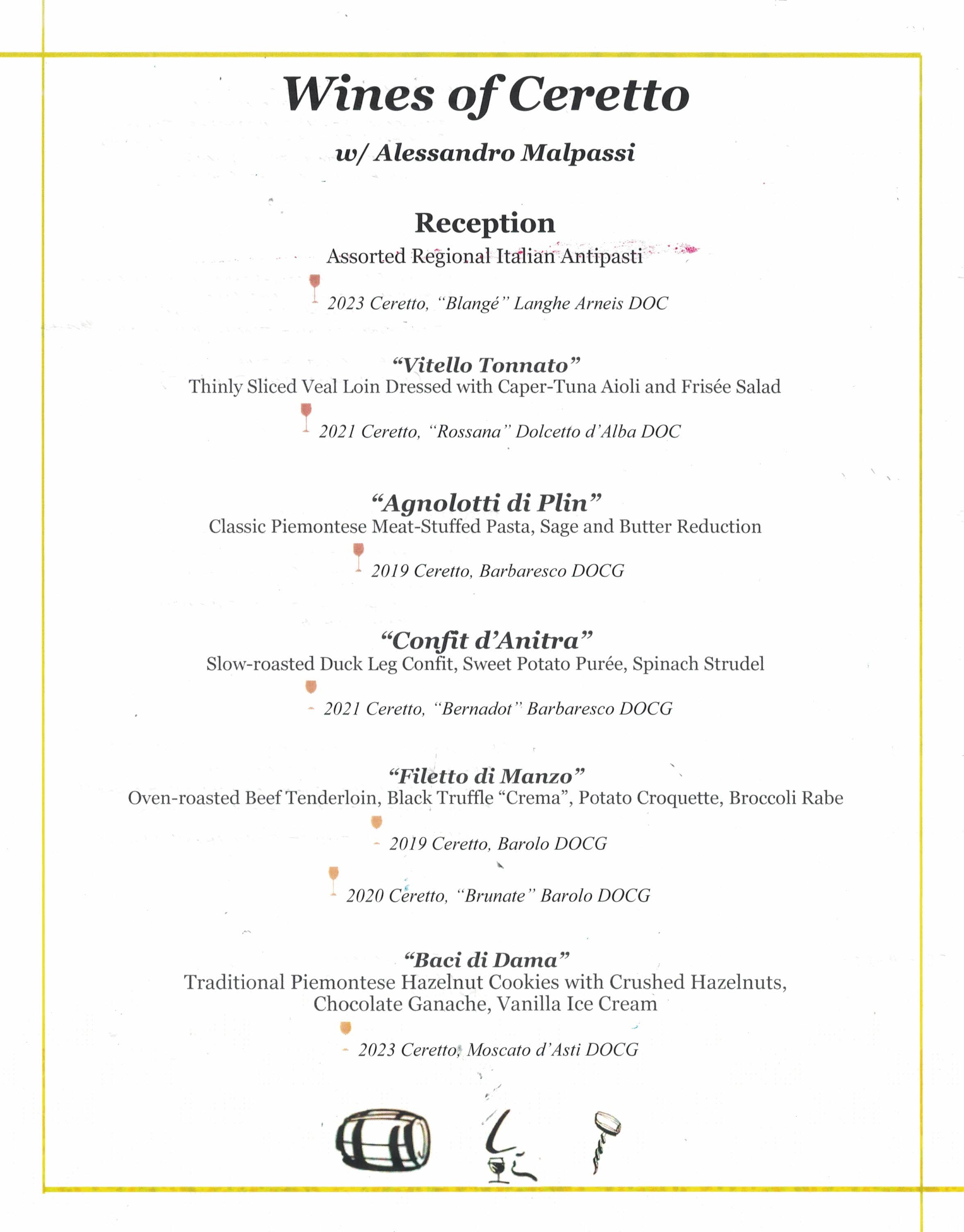
2023 Ceretto Blange, Arneis, Langhe
100% Arneis
Floral nose, bright with honeysuckle hints. Lovely. Light-bodied with moderate acidity. Well-balanced. Crisp with a hint of frizzante. Peach, apricot and slate notes. Clean and refreshing on the aftertaste. Delightful.
The wine was paired with an assortment of passed Italian Antipasti.

2021 Ceretto Rossana, Dolcetto d’Alba
100% Dolcetto
Tight nose with cherry, herb, and crushed rose petal hints. Medium-bodied with firm acidity. Well-balanced with firm, dry tannins. Black cherry. Dark fruit and earthy notes. Long finish. Tight aftertaste. Very young.

The wine was paired with Vitello Tonnato – Thinly Sliced Veal Loin Dressed with Caper-Tuna Aioli and Frisee Salad.

2019 Ceretto, Barbaresco DOCG
100% Nebbiolo
Dried cherry nose with leather and violet hints. Medium-bodied with moderate acidity. Well-balanced with moderate tannin. Dark fruit core with dried cherry – tarry. Dried strawberry and dried violet notes. Long finish with layered complexity and anise on the aftertaste.

The wine was paired with Agnolotti di Plin – Classic Piemontese Meat-Stuffed Pasta, Sage and Butter Reduction.

2021 Ceretto Bernadot, Barbaresco DOCG
100% Nebbiolo
Vibrant nose. Bright cherry, earthy, crushed violet hints. Medium-bodied with firm acidity. Well-balanced with firm tannin. Tart, sour cherry palate. Very young. Long finish. Closed and clumsy. Not showing well tonight…

The wine was paired with Confit d’Anitra – Slow-Roasted Duck Leg Confit, Sweet Potato Puree, Spinach Strudel.

2019 Ceretto, Barolo DOCG
100% Nebbiolo
Dried cherry nose with violet, leather, and strawberry hints. Medium-bodied with moderate acidity. Well-balanced with firm, dry tannin. Dark fruit core with sour cherry and dried strawberry notes. Long finish. Tight with rose petals and dried herbs on the aftertaste.

2020 Ceretto Brunate, Barolo DOCG
100% Nebbiolo
Tight nose. Dried cherry and crushed rose petal hints. Medium-bodied with firm acidity. Well-balanced with firm, aggressive tannin. dark fruit core with tar and anise notes. Long finish. Tight. Dark and brooding. Rose attar on the aftertaste.

The wine was paired with Filetto di Manzo – Oven-Roasted Beef Tenderloin, Black Truffle Crema, Potato Croquette, Broccoli Rabe.
Sorry no picture – but the last wine was a delightful Moscato d’Asti.
2023 Ceretto, Moscato d’Asti DOCG
100% Moscato
Exotic nose with rose water and honeysuckle hints. Light-bodied with firm acidity. Lightly effervescent. Well-balanced with elegance and playfulness. Creamy. Delightful.
The meal was concluded with Baci di Dama – Traditional Hazelnut Cookies with Crushed Hazelnuts, Chocolate Ganache, Vanilla Ice Cream.

And again, David and his crew produced another phenomenal event!
Thank you! Cheers!