
Prima Steakhouse, Charlestown, MA


I recently had the pleasure of spending the evening at Prima Steakhouse enjoying the wines of Giacomo Borgogno & Figli, one of the oldest producers in Barolo. The wines were presented by Fabio Valpreda, Borgogno’s Export Manager, along with the always vivacious Aurora Gurrado from Ethica Wines.
Before we dive into the wine tasting itself, let’s explore more about Giacomo Borgogno & Figli.


Borgogno: The Timeless Heart of Barolo
Few names in Piedmont carry the weight of Borgogno, a winery whose roots reach back to 1761, making it the oldest historic cellar in the village of Barolo. To walk into Borgogno today is to step into a living archive of Langhe winemaking: cool underground tunnels lined with ancient concrete fermenters, towering Slavonian oak botti, and a library of bottles stretching across generations. Tradition isn’t a marketing phrase here, it’s the operating system.
A Legacy Shaped Over Centuries
Borgogno began with Bartolomeo Borgogno, but it was Cesare Borgogno in the early 20th century who transformed the estate into an ambassador of Barolo. He was among the first to export Barolo widely, helping introduce Nebbiolo to an international audience. After Cesare’s death in the 1960s, the estate remained in family hands until 2008, when the Farinetti family—founders of Eataly—acquired it. Their stewardship has been defined by respect for tradition paired with thoughtful modernization, including a full conversion to organic farming, certified in 2019.
Vineyards: A Patchwork of Barolo’s Most Storied Crus
Borgogno farms roughly 93 acres across Barolo, Alba, and Monleale, with more than 60% dedicated to Nebbiolo. Their Barolo identity is anchored in a set of classic vineyards that define the style of the village:
- Cannubi — Barolo’s most famous hill, known for elegance, perfume, and fine tannins.
- Liste — A more austere, structured site that gives vertical, long-lived wines.
- Fossati, San Pietro delle Viole, and Cannubi San Lorenzo — Additional parcels that contribute complexity to the Barolo Classico.
Outside Barolo, Borgogno also cultivates Timorasso in the Colli Tortonesi and maintains plantings of Dolcetto, Barbera, Freisa, and small amounts of Riesling—a surprisingly successful experiment in the Langhe’s cooler pockets.
Winemaking: Tradition as a Guiding Principle
Borgogno is one of the last great holdouts of old-school Barolo. Their approach is defined by:
- Spontaneous fermentations in original concrete tanks
- No selected yeasts
- Long macerations
- Extended aging in large Slavonian oak botti—never barrique
- Minimal intervention and no chemical fertilizers or herbicides in the vineyard
This philosophy yields Barolo of depth, structure, and longevity—wines that often need time but reward patience with haunting aromatics and remarkable complexity.
The Wines: A Portfolio Rooted in Nebbiolo, Enriched by Heritage
- Barolo Classic: A blend of the estate’s five Barolo vineyards aged at least four years in large oak. This is Borgogno’s signature: firm, savory, and built for aging.
- Barolo Riserva: Borgogno is famous for its Riservas, often released after a decade or more in bottle. Vintage verticals from the 1950s through the 1980s are legendary among collectors, and the estate still holds deep library stocks.
- Single-Cru Barolo: Liste: A wine of power and structure, reflecting the vineyard’s compact soils and higher elevation. Expect darker fruit, iron, and a long, architectural finish.
- Langhe Nebbiolo: Made from the same vineyards as Barolo but vinified for earlier approachability—still unmistakably Nebbiolo in its aromatics and tannin.
- Timorasso “Derthona”: A standout white wine from an ancient Piedmontese grape revived by a handful of producers, including Borgogno. Rich, mineral, and age-worthy—often called “the white Barolo.”
- Freisa, Barbera, Dolcetto: Classic Piedmont reds that showcase the region’s diversity. Freisa is a point of pride for Borgogno, who champion its preservation as Nebbiolo’s ancient relative.
A Living Museum of Barolo
One of Borgogno’s most fascinating features is its historic cellar, where original concrete tanks still line the walls and decades of Riservas rest quietly in bottle. Visitors often describe the experience as stepping into a time capsule—an impression reinforced by the winery’s commitment to doing things “the slow way,” as they put it.
The estate’s philosophy is simple: more nature, less chemistry; more patience, less manipulation. It’s an approach that has kept Borgogno at the center of Barolo’s story for more than 250 years.most beautiful vineyard landscapes in Italy.

Now for a recap of the evening’s wine tasting dinner, which began with the estate grown Riesling, a very rare and intriguing wine and not something that I had experienced to date.

2022 Borgogno Era Ora Riesling, Langhe DOC
100% Riesling
Tight, citrusy nose with light petrol, pear, and apricot hints. Medium-bodied with firm acidity. Well-balanced with great structure. Long finish. Lemony aftertaste with salinity and minerality. Very nice. (Note: The term Era Ora means About Time, referencing a comment made by the matriarch of the Borgogno family, when she said, and I paraphrase in English, “It’s about time you made a white wine!”)

2023 Borgogno Freisa, Langhe DOC
100% Freisa
Fruity and bright nose with cherry and fresh herb hints. Medium-bodied with firm acidity. Well-balanced with moderate tannin. Dark fruit core with black cherry and rose attar notes. Long finish. Tight. Licorice on the aftertaste. Solid. (Note: Very limited production.)

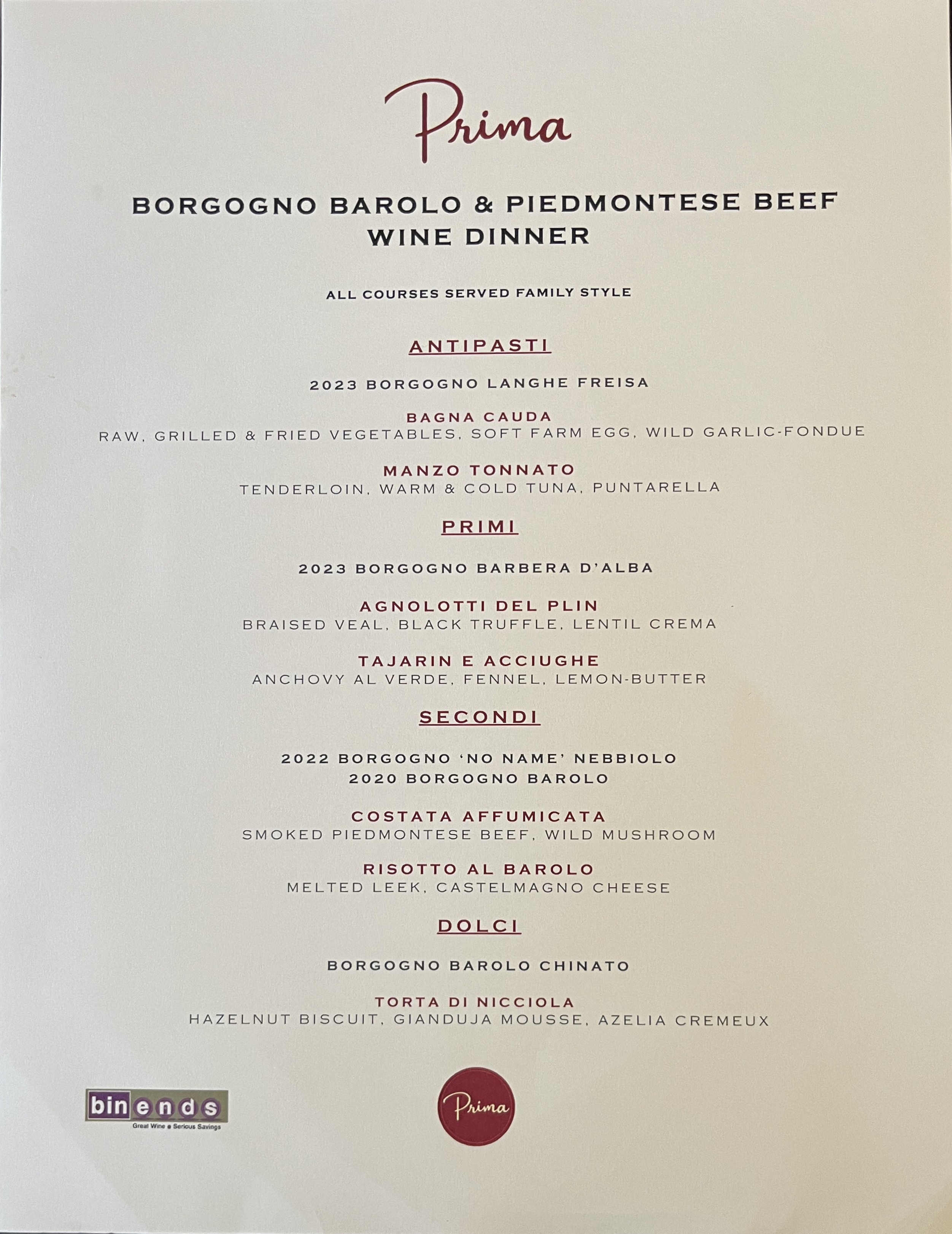
The wine was paired with Bagna Cauda – Raw, Grilled & Fried Vegetables, Soft Farm Egg, Wild Garlic Fondue.

Manzo Tonnato – Tenderloin, Warm & Cold Tuna, Puntarella.

2023 Borgogno, Barbera d’Alba DOC
100% Barbera
Tight, black cherry nose. Anise and violet hints. Medium-bodied with firm acidity. Well-balanced with moderate tannin. Dark fruit core with fresh cherry, strawberry, and fresh herb notes. Long finish. Fresh and floral. Lovely. (Note: Vineyards have an average vine age of 50-60 years.)

The wine was paired with Agnolotti Del Plin – Braised Veal, Black Truffle, Lentil Crema.

Tajarin E Acciughe – Anchovy Al Verde, Fennel, Lemon-Butter.

2022 Borgogno No Name, Nebbiolo Langhe DOC
100% Nebbiolo
Black cherry nose with violet, anise, and fresh herb hints. Medium-bodied with firm acidity. Well-balanced with firm, dry tannins. Dark fruit core with black cherry, attar, and licorice notes. Long finish. Tight. Great potential. (Note: This wine was supposed to be a second bottling of the estate Barolo, but because of arcane wine law in Piedmont, the wine could only carry the Nebbiolo Langhe designation – Truly a “Wine of Protest.”)

2020 Borgogno, Barolo DOCG
100% Nebbiolo
Tight nose. Lightly floral with cherry, anise, and violet hints. Medium-bodied with firm acidity. Well-balanced with firm, dry tannins. Dark fruit core. Chewy. Black cherry and licorice notes. Long finish. Tight. Dried strawberry on the aftertaste.

The wine was paired with Costata Affumicata – Smoked Piedmontese Beef, Wild Mushroom.

Risotto Al Barolo – Melted Leek, Castelmagno Cheese.

Borgogno, Barolo Chinato
100% Nebbiolo
Sweet, strawberry nose. Quinine and almond skin hints. Medium-bodied with moderate acidity. Well-balanced with firm tannin. Exotic palate. Contemplative. Long finish. Absolutely charming.

The wine was paired with Torta Di Nicciola – Hazelnut Biscuit, Gianduja Mousse, Azelia Cremeux.
A delightful evening with some very nice wines, delicious food and engaging stories.
Thank you!
Cheers!