

One of my favorite classes to teach is The History of Italy in Ten Glasses.
A few years ago, during one of my History of Italy in Ten Glasses classes, we were discussing the Roman roots of Italian wine while tasting a Valpolicella. A student stopped, looked down at their glass for a moment, and then said:
“I never realized I was drinking history.”
I smiled because they had just captured the entire purpose of the class. Wine is never just wine. Every bottle contains a story. Sometimes that story spans decades. Sometimes it spans centuries. And sometimes it leads us all the way back to Ancient Rome.
That’s when things get really interesting. Because if there is a single civilization that arguably shaped the modern world of wine, it was Rome.
Not the Rome of emperors and gladiators. But the Rome of vineyards. The Rome of farmers. The Rome of merchants and agricultural innovators.
When most people think about Roman accomplishments, they think about roads, aqueducts, architecture, and military conquest.
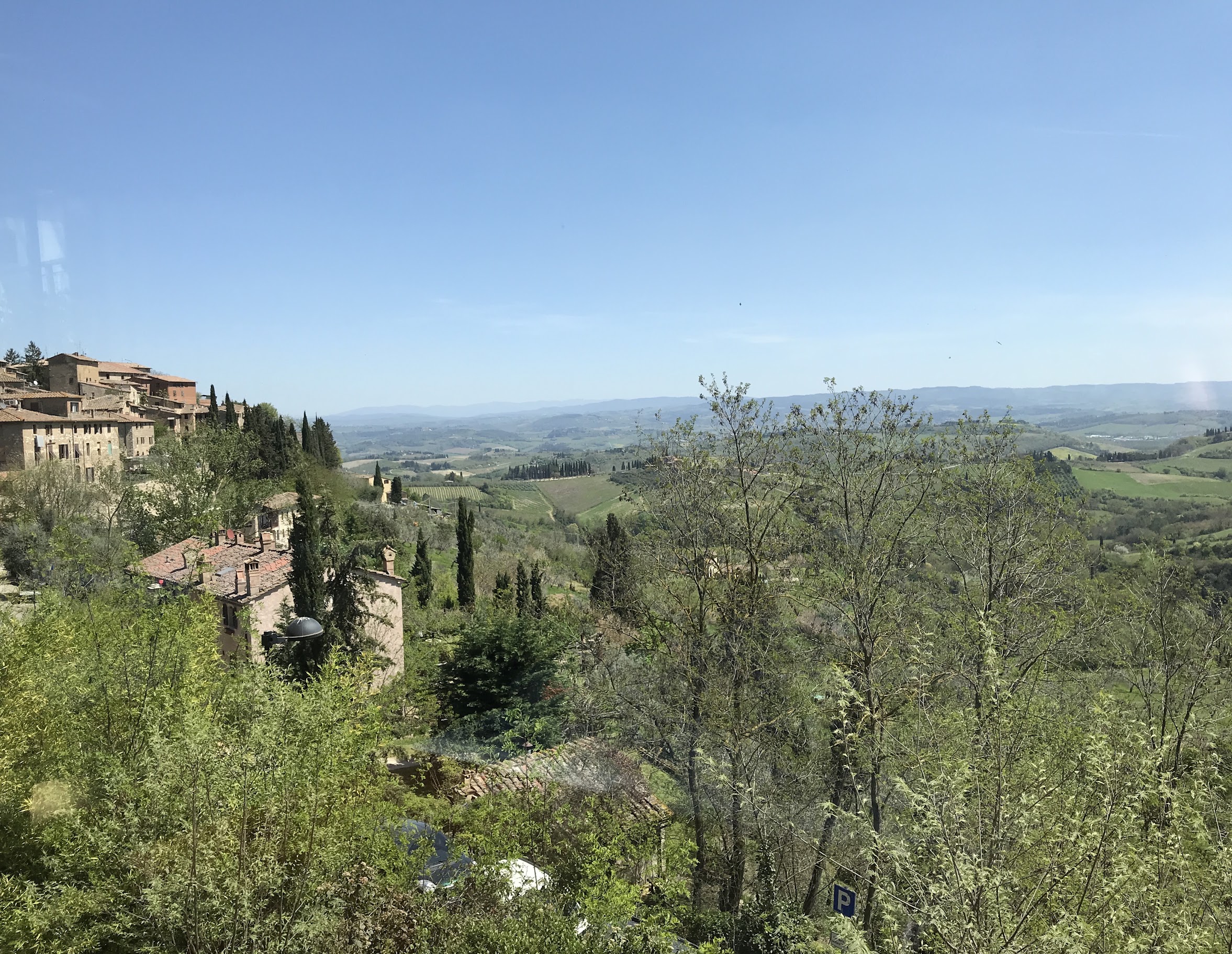
When we visited Italy in 2018, I was reminded that history is not confined to museums or textbooks. It exists in church towers, stone farmhouses, ancient roads, and vineyard-covered hillsides. In many places, the landscape itself feels like a conversation between the past and the present.
For instance, when we were in San Gimignano, I looked across a vineyard shaped by centuries of human hands and wondered how many generations had worked that same ground before me. The answer is almost impossible to comprehend.
Nowhere is that more apparent than in wine.
The Romans Didn’t Invent Wine. They Perfected Its Potential.
To be fair, the Romans did not invent wine.
Long before Rome emerged as a dominant power, wine was already being produced throughout the Mediterranean world. The Greeks, Phoenicians, and Egyptians all cultivated vines and enjoyed wine as part of everyday life. What Rome did was arguably even more important.
The Romans transformed wine from a regional agricultural product into one of the defining elements of Western civilization.
They studied it. Recorded it. Improved it. Commercialized it.
And most importantly, they spread it.

Rome Carried the Vine Across Europe
One of history’s great ironies is that many of today’s most celebrated wine regions owe part of their existence to Roman expansion.
Wherever Roman roads extended, vineyards were never far behind. The Romans understood something that every wine lover understands today: if you are going to build a civilization, it helps to have good wine. Soldiers marched into new territories carrying more than shields and spears. Merchants followed. Farmers followed. And eventually, so did the vine. The Romans didn’t simply conquer territory. They exported an entire agricultural philosophy.
Think about that for a moment.
When we enjoy a bottle of Burgundy, Rhône Valley wine, Rioja, or Riesling from the Mosel, we are experiencing a legacy that Roman agricultural policy helped establish two thousand years ago.
History leaves long shadows.
Few are longer than this.
The Romans Understood Terroir Before It Had a Name
One of the topics I discuss frequently in my classes is terroir.
The word is often overused, but the concept is beautifully simple. Certain grapes perform better in certain places. Today we have climate models, soil analyses, satellite imagery, and centuries of scientific research to help explain why.
The Romans had none of those tools. What they possessed was something that remains invaluable today: patience.
They observed. They experimented. They paid attention. Over generations, they began to understand something that every serious winegrower eventually discovers. Nature is constantly speaking. The challenge is learning how to listen.
The Romans listened.
They may not have understood the chemistry, the microbiology, or the climatology behind what they observed. But they recognized the results.
In other words, they discovered one of the most fundamental truths of fine wine:
The right grape planted in the right place can produce something extraordinary.
Long before there was a scientific vocabulary for terroir, the Romans understood its essence. Eventually, all that observation, experimentation, and vineyard management produced something every civilization seems to crave: A legendary wine.

Falernian: The First Great Luxury Wine
No discussion of Roman wine would be complete without Falernian.
Produced on the slopes of Mount Massico in Campania, Falernian became one of the most celebrated wines of the Roman world. Poets praised it. Statesmen served it. The wealthy collected it. It was discussed, admired, and sought after throughout the Empire.
“What did Falernian actually taste like?”
The honest answer is that nobody knows.
And yet, in a strange way, that mystery makes Falernian even more fascinating.
Whenever I discuss Falernian in class, I remind students that every generation has its legendary wines. Today we might debate First Growth Bordeaux, Grand Cru Burgundy, or cult Napa Cabernet. Two thousand years ago, Romans had remarkably similar conversations.
For perhaps the first time in recorded history, a wine achieved something approaching international prestige.
Many of the concepts we associate with modern fine wine were already taking shape.
Rome and the Mystery of Aging Wine
Of all Rome’s contributions to wine, this is the one I find most intriguing.
As many readers know, I have long been fascinated by wine’s life cycle.
Unlike a painting or a sculpture, wine is alive. It is born. It evolves. It matures. And eventually, it fades.
The Romans recognized this.
They understood that certain wines improved with age. They discussed mature wines, documented their observations, and developed methods for storing wines intended to evolve over time.
Perhaps that is what I find so compelling about both wine and history. Neither is static. Both are ultimately studies of change over time. The Romans weren’t just growing grapes. They were learning patience. They were discovering that time itself could become an ingredient.
What fascinates me is that they were wrestling with the same mystery that captivates wine lovers today.
How can a simple grape transform itself through the passage of time into something entirely different?
After forty years of tasting wine, cellaring wine, teaching wine, and occasionally waiting far too long to open a bottle, I remain captivated by that transformation. Fine wine is one of the few forms of art that is truly alive. A painting changes very little over time. A sculpture remains largely unchanged. A wine is different. A wine has a life story.
Wine Was the Common Language of the Empire
Wine was more than a beverage in Roman society. It was woven into nearly every aspect of daily life. It played a role in commerce, religion, politics, agriculture, and social customs.
A merchant in Hispania, a farmer in Gaul, and a senator in Rome might have had little else in common, but they all understood wine. It fueled trade. It encouraged innovation. It became one of the threads that helped hold a vast empire together. In many respects, wine served as a common language spoken throughout the Roman world.
The more I study Roman history, the more I appreciate how influential wine truly was.
Why Rome Still Matters
Every time I teach The History of Italy in Ten Glasses, I am reminded that history isn’t really about the past.
It’s about understanding how we arrived at the present.
Every bottle we open today represents thousands of years of experimentation, observation, failure, discovery, and craftsmanship. Few civilizations contributed more to that journey than Rome.
The next time you pour a glass of wine, take a moment to consider how much history is contained within it.
There’s a good chance that part of the answer leads back to a Roman farmer standing on a hillside two thousand years ago, studying the land, observing the weather, and wondering whether a particular vine might thrive there.
Thankfully, many of them decided to find out.
And perhaps that student was right all along.
We are drinking history.
And because they did, we can still experience the remarkable intersection of history, place, craftsmanship, and time in a single glass.
In that sense, every glass still carries a little of Rome with it.
