
Cappella Restaurant – Needham, MA

I would suggest that there are as many cocktail recipe books as there are bars in America. And yet, there are a few that are considered “go-to” bibles for the eagerly thirsty set. Enter David A. Embury, who in 1948 wrote The Fine Art of Mixing Drinks, considered by generations of young men the definitive reference for all things alcoholic. In the book, Embury defines the six classic cocktails: Daiquiri, Jack Rose, Manhattan, Martini, Old Fashioned, and Sidecar. Each of these cocktails is based on a few simple principles:
- It should be made from good-quality, high-proof liquor.
- It should whet rather than dull the appetite. Thus, it should never be sweet or syrupy, or contain too much fruit juice, egg or cream.
- It should be dry, with sufficient alcoholic flavor, yet smooth and pleasing to the palate.
- It should be pleasing to the eye.
- It should be well iced.
Embury also defines a cocktail as consisting of three basic components:
- The base is the principal ingredient of the cocktail. It is typically a single spirit such as rum, gin, or whiskey, and typically makes up 75 percent or more of the total volume of the cocktail before icing.
- The modifying agent is the ingredient that gives the cocktail its character. Its function is to soften the raw alcohol taste of the base while enhancing its natural flavor. Typical modifying agents are aromatic wines (such as vermouth) and spirits (such as Fernet Branca or Amer Picon), bitters, fruit juices and “smoothing agents” such as sugar, eggs, and cream.
- Special flavoring and coloring agents include liqueurs (such as Grand Marnier or Chartreuse), Cordials, bitters like Angostura Bitters, etc. and non-alcoholic flavored syrups (such as grenadine or orgeat syrup). These are typically used in place of simple syrup and are to be used sparingly.
Embury further breaks all cocktails down into two categories:
- Cocktails of the aromatic type, use as modifying agents bitters or aromatic wines or spirits.
- Cocktails of the sour type use as modifying agents a fruit juice (typically lemon or lime) and sugar. For these a ratio of 1 part sweet to 2 parts sour, to 8 parts base is generally recommended. However, Embury makes it very clear that he thinks the idea that a drink must be made according to one exact recipe preposterous, and that the final arbiter is always your taste. He suggests trying different ratios, finding the one that is most pleasing to you, and sticking with it.
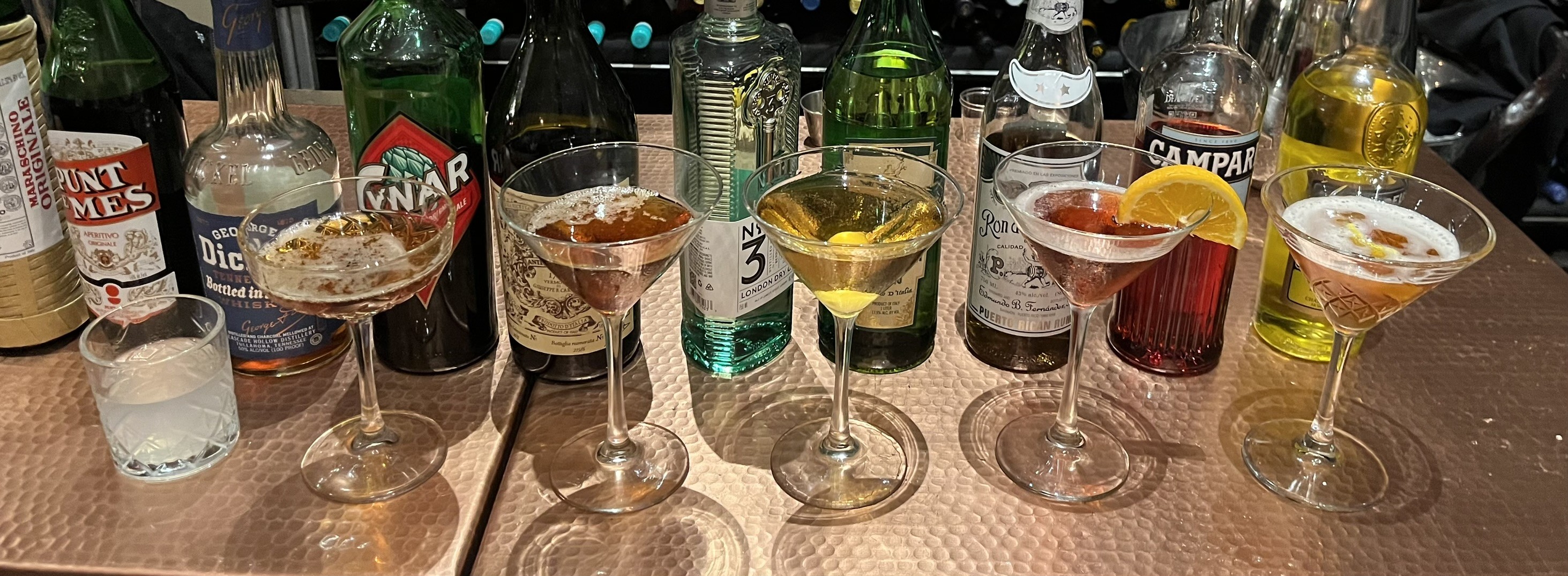
The following six cocktails are considered Modern Classics, taking their cue from the six classic cocktails named by Embury.

Golden Glove (Daiquiri)
- 2 oz. White Rum
- 1 oz. Cointreau
- ½ oz. Lime Juice
- 1 tsp. Simple Syrup
Build the cocktail in a Boston Shaker with ice and then strain into a rocks glass over ice, or into a chilled cocktail glass, up. Garnish with a lime slice.
The Golden Glove can be traced back to the “Bar La Florida” recipe booklet, which was published in 1935 by Constante Ribalaigua Vert, owner of the Floridita bar in Havana. The watering hole is famous for serving venerable regulars like Ernest Hemingway and for turning out some of the best drinks in Havana. That includes the Golden Glove. Consisting of rum, lime juice, sugar and Cointreau, it’s like a Daiquiri-Margarita hybrid. But Ribalaigua, a boxing fan, fashioned the cocktail as a riff on his Daiquiri No. 2, which featured orange liqueur and orange juice in addition to the trifecta of rum, lime and sugar.

Red Hook (Jack Rose)
- 2 oz. Rye Whiskey
- ½ oz. Maraschino Liqueur
- ½ oz. Punt é Mes
Build the cocktail in a Boston Shaker with ice and then strain into a chilled coupe, up. Garnish with an Amarena cherry in syrup.
The Red Hook calls for rye whiskey, maraschino liqueur and Punt e Mes, an Italian vermouth whose name translates to “point and a half,” referring to the bottle containing one point of sweetness and one point of bitterness. The cocktail was created by Vincenzo Errico at the famed Milk & Honey bar in 2003 and has become one of the most enduring contemporary cocktails, popping up at bars across the country.

Black Manhattan (Manhattan)
- 2.5 oz. Bourbon Whiskey
- 1/2 oz. Cynar
- Dash Angostura bitters
Build the cocktail in a Boston Shaker with ice and strain into a chilled cocktail glass or coupe. Garnish with an Amarena cherry in syrup.
The Black Manhattan is a subtle spin on that quintessential American cocktail. First created in 2005 by Todd Smith during his stint at Cortez in San Francisco, the drink has truly become a modern classic, popping up at bars across the US.

The Perfect Martini (Martini)
- 3.5 oz. London Dry Gin
- ½ oz. Dry Vermouth
- ½ oz. Sweet Vermouth
Build the cocktail in a Boston Shaker with ice and strain into a chilled cocktail glass. Garnish with a cocktail onion.
The term “perfect” in bar tending has a specific meaning, and applies to any cocktail made with either sweet, or dry vermouth. When you halve the total amount of vermouth into equal parts sweet and dry, you create what is termed a “perfect” cocktail.

Kingston Negroni (Old Fashioned)
- 1 oz. Dark Rum
- 1 oz. Carpano Antico
- 1 oz. Campari
Build the cocktail in a Boston Shaker with ice and strain into a chilled cocktail glass. Garnish with an orange twist.
Like the Manhattan, the Old Fashioned is quintessentially American and literally was the “first” cocktail mentioned in print back in 1806. Rather than tweak the world’s simplest drink, one twist that riffs on another modern classic, the Negroni takes this to an entirely different plane. Swapping out the botanical gin in favor of a notoriously flavorful and funky overproof Jamaican rum, is what Joaquín Simó, bartender and partner in New York City bar Pouring Ribbons, did when he first made the drink in 2010..

Ce Soir (Sidecar)
- 2 oz. Cognac
- ¾ oz. Cynar
- ½ oz. Yellow Chartreuse
- Dash Angostura Bitters
- Dash Regan’s Orange Bitters
Build the cocktail in a Boston Shaker with ice and strain into a chilled cocktail glass. Express a lemon twist over the cocktail and discard it.
Eastern Standard, and its sister bar, The Hawthorn, are mainstays in the modern cocktail revolution. Nicole Lebedevitch had a regular at Eastern Standard named Nate, who she regaled with subtle variations on classic cocktails. Over time, one riff seemed to stick and in 2011 the Ce Soir was officially introduced to the menu. The rest is history.


